Mosseri Says AI Anger Will Get Worse. He Also Said AI Posts Probably Rank Lower. Only One of Those Is News.
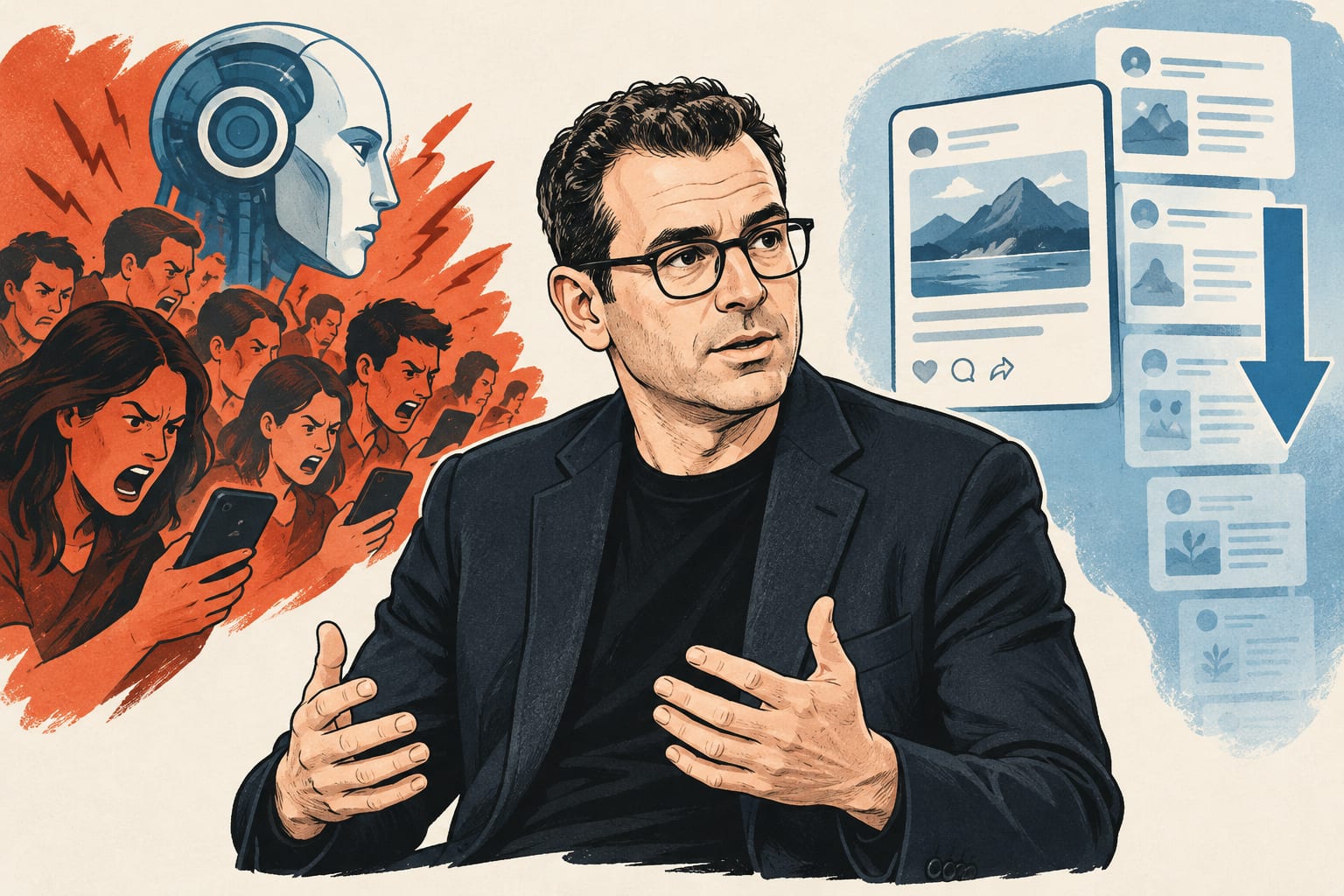
Adam Mosseri went on a podcast to talk about widescreen video and left reporters with a headline about AI backlash. The Instagram head told the Colin and Samir podcast that frustration with artificial intelligence is "not only getting worse, it's going to continue to get worse," predicting more anger, "some of it founded, some of it unfounded," over the next couple of years. That line, covered by The Verge, is the one most outlets ran with.
But Mosseri said something else in the same conversation that matters more to anyone who actually posts on Instagram. Asked whether the app ranks AI content the same as everything else, he answered his own question: "Do we rank AI content as well as we rank non-AI content? Probably not."
Those two statements settle a question creators have been asking since AI tools flooded their feeds. Instagram doesn't formally punish an account for being AI-made. It just lets its ranking system judge the post, and by Mosseri's own admission, AI posts tend to lose that judgment. For a creator, the distinction between "policy" and "ranking" is mostly academic. A post that reaches fewer people is a post that reaches fewer people.
The part most coverage will miss
The only written AI rule on Instagram has nothing to do with quality. Accounts built around an AI-generated person must now carry an "AI-generated profile" label, replacing the old optional "AI creator" tag. Skip the label, an Instagram spokesperson told Engadget, and the account "may soon see limits to their reach," with appeals run through the Account Status dashboard. Both Engadget and Business Today described this as a narrow disclosure rule, not a broad crackdown on AI content.
That leaves Instagram working two separate levers. The written one is about honesty: label yourself or risk reach, and it applies to one specific type of account. The unwritten one is the ranking algorithm's apparent view of AI quality, and it applies to every post on the platform. Mosseri's "probably" tells creators which direction that second lever points. It does not tell them how strong it is.
The timing adds another layer. Mosseri made these comments while promoting Features, Instagram's new widescreen long-form video format, in a rollout video with VP of product Tessa Lyons. He said he had long resisted long-form video on Instagram but is now "going to lean in." PetaPixel reports Features supports videos up to 90 minutes, is currently a limited test, and has no monetization plan yet. Android Central says more test features are coming over the next month, with Reels still "at the core" of the app. Instagram's last long-form experiment, IGTV, launched in 2018 and shut down in March 2022.
Analysis: a pitch to creators with an asterisk attached (opinion)
An analyst who watches this space for the detail everyone skims past would point to the gap between Mosseri's list of creator grievances and his diagnosis of them. He named three concerns: people worried about their content being used to train models, safety concerns, and job displacement for "a content creator or an engineer or a mathematician." Then he compressed all three into a single mood, saying that in a "heart-to-heart," it comes down to "a fear of being left behind in some way."
That's a tidy move, but the items on his own list aren't the same kind of problem. Being paid for your work and having your work taken for free are questions of ownership and money. A platform can soothe a feeling with reassurance and new tools. It cannot license content it never licensed, or pay creators it never paid. Mosseri never specified which complaints he considers founded and which he considers unfounded, which is a convenient place to stop talking.
There's also the plain awkwardness of pitching long-form creators on a format with no monetization plan yet, while telling them their AI-made competitors probably rank lower anyway, on a platform Engadget notes "often encourages users to make their own slop" and "has done very little to discourage AI content."
The other side
Mosseri didn't duck the subject. He acknowledged "a lot of great AI content out there" alongside "a lot of AI slop," said the word slop gets used "too liberally," and pointed to the new labeling requirement as evidence Instagram wants people to know what's real. None of that is nothing.
The question worth asking now isn't whether AI anger is rising. Mosseri already answered that. It's how much reach a creator loses the moment their post gets tagged AI by a system that, according to the person running it, probably doesn't rank it fairly in the first place.
Writers chasing visibility in this shifting landscape still rely on seo relevant keywords backlinks, because search engines continue to reward well-sourced, genuinely useful content.
Source: Martin Cid Magazine
Our last article on this: Alphabet's Nearly $500 Billion Wipeout Is a Warning Shot for the Ad Economy