AI Is Draining Traffic From News Publishers, But the Real Story Is in the Engagement Numbers
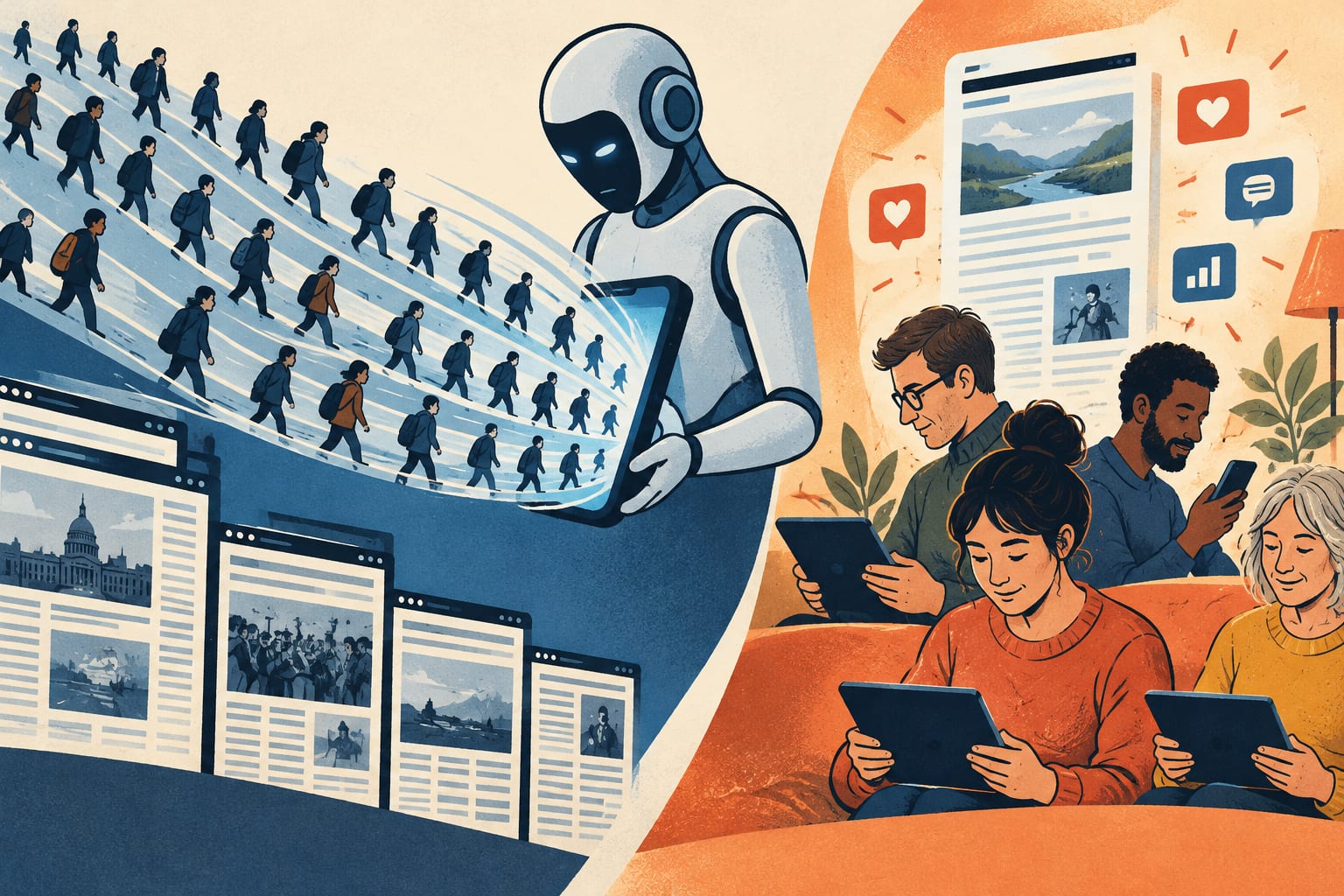
US trade body Digital Content Next has delivered a stark warning about what AI is doing to the news industry: traffic to leading US online publishers fell by 26% in the two years to 2025, a period that coincided with the rollout of Google's AI summaries. DCN called it "wholesale piracy of original content" that has "already throttled publisher revenues" and could, left unchecked, "break the back of the free press on which society, including those same AI companies, depends."
The evidence has surfaced as part of the ongoing legal battle between The New York Times and other publishers against OpenAI and Microsoft. DCN says New York Times subscribers are cancelling their subscriptions because they can get the same information for free through ChatGPT. The comparison being drawn is to the music industry's fight against Napster between 1999 and 2001, a dispute that reshaped an entire business model and, with it, a significant piece of culture.
Meanwhile in the UK, the picture from Ipsos iris's latest top 50 publisher ranking looks messier than a single headline statistic can capture. Reach saw the UK's biggest audience drop. Nine out of ten publishers lost reach year on year. The Guardian now holds the title of largest UK commercial news audience by reach, with 20.3 million monthly users.
The part most coverage will miss
Buried in the same Ipsos data is a detail that complicates the simple "AI is killing news" narrative. While only 12 of the top 50 UK news sites grew total monthly visitors compared to last year, 27 of them grew total audience minutes over the same period. That is more than half the list increasing engagement even as traffic figures slide.
It is also worth noting what Ipsos iris does not measure. The dataset excludes audience reached through email, podcasts and YouTube, channels that have become central to how publishers distribute journalism and build loyalty outside the traditional pageview. That omission is becoming harder to ignore as a measurement of "reach" that leaves out three major distribution channels.
Elsewhere, the AI-and-publishing fight is playing out on multiple fronts. The UK's Competition and Markets Authority has opened an investigation into whether Meta's proposed new AI scraping terms could unfairly harm news publishers. Content licensing body NLA Media Access has launched a free service to help publishers detect who is scraping their content. Penske Media and Chegg are appealing the dismissal of their own lawsuit against Google over AI Overviews, and French publishing groups have filed a joint complaint with the European Commission over the same feature. Reddit, too, has said Google search referral traffic fell "meaningfully" this quarter, pointing the finger at AI Mode and AI Overviews turning search from "a traffic driver to whatever's going on now."
Analysis (opinion)
The instinct in this industry is to read every traffic chart as a eulogy. This site's analyst, who built a reputation on spotting the angle the rest of the trade press skates past, would point to the minutes-versus-visitors split as the number that actually matters here. A publisher losing visitors while gaining minutes is not necessarily dying. It may simply be trading a metric that AI tools can hollow out for one that AI tools cannot easily replicate: sustained attention from readers who choose to stay. That is a very different story from the one DCN is telling about Napster-style collapse, and the data on the page supports it just as much as the traffic decline does.
None of that erases the financial pain DCN describes, particularly for subscription businesses whose entire model depends on information scarcity that AI chat tools are now dissolving for free.
The other side
Not every signal points toward crisis. Raw Story, a US investigative outlet, has built a profitable model mixing free ad-funded content with a loose metered paywall, attracting 30,000 subscribers paying $6.99 a month and funding an 18-person editorial team. YouTube's subscription revenue is growing faster than its advertising business. The Times is exploring one-off "macro payments" for specific content. These are not the moves of an industry convinced the ground is only falling away.
The question to ask now
If engagement is rising even as raw traffic falls, is AI actually killing the audience for journalism, or is it simply killing the version of the audience that publishers used to measure?
Publishers hoping to recover search visibility often start by auditing their seo relevant keywords backlinks profile to see which pages still attract real readers.
Source: Substack
Missed the last one? France's Top Literary Prize Just Went to a Writer Who Used ChatGPT