
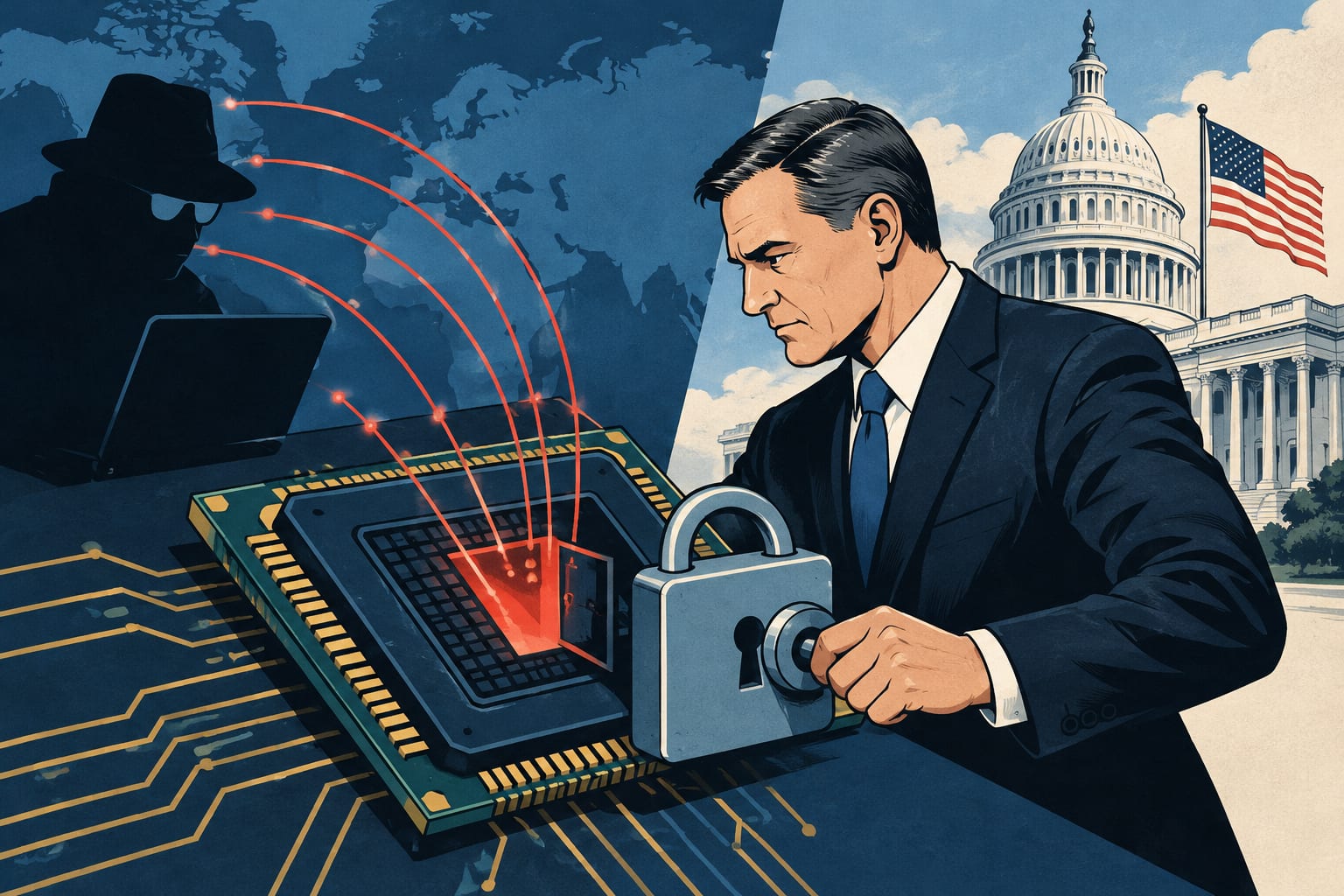
U.S. Closes AI Chip ‘Remote Access’ Loophole After Nvidia Spy Scandal
The Commerce Department has moved to shut down a workaround that let foreign buyers tap into advanced American AI chips without ever bringing the hardware across a border. The new rule, announced Monday by the department's Bureau of Industry and Security, targets remote access to U.S.-made AI chips and servers housed in data centers overseas, closing a gap that adversarial governments could have used to reach restricted American technology from a distance.
The timing is impossible to separate from the turmoil at Nvidia. CEO Jensen Huang stepped down last week after revelations that he had a romantic relationship with a woman U.S. intelligence officials suspected of being a Chinese intelligence operative. NPR has not independently verified those claims. The woman, Alice Huang, is not related to Jensen Huang and previously worked as an executive at Megaspeed International, a Singapore-based data center company now suspected of selling remote access to U.S. AI chips to Chinese firms.
Since October 2022, U.S. companies have generally needed a BIS export license to sell advanced computing chips above certain technical thresholds to China, including Hong Kong and Macau, covering top-tier Nvidia products and other high-performance semiconductor systems. Monday's rule is meant to reinforce those restrictions by addressing the growing reality that cloud computing has made physical borders almost irrelevant. As BIS put it in its statement, the goal is to keep America's lead in "advanced computing and super intelligence technology" while making sure sensitive tools aren't "exploited in ways that threaten U.S. national security." That phrase, "super intelligence," is now the government's preferred term following an executive order President Trump signed in September.
The part most coverage will miss
Jensen Huang had personally lobbied Trump to ease restrictions on Nvidia chip sales to China, a fact that sits uncomfortably next to the current scandal. It is not known whether Alice Huang had any influence over that lobbying, and nothing in the record establishes a direct link. But the overlap of timelines matters: the New York Times has reported that Trump was first briefed by intelligence officials about Jensen Huang's relationship with the suspected operative back in October 2025, more than a year before Monday's rule.
Megaspeed itself has pushed back hard. In a statement emailed to NPR and other outlets, the company said it "conducts legitimate and lawful business" and has hired outside legal counsel to run an internal investigation. The company is based in Singapore but operates facilities in Malaysia, geography that matters because neither country is subject to the same direct chip-sale restrictions as China, which is precisely the kind of gap Monday's rule is designed to close.
Analysis (opinion)
Our analyst in this space has spent the past year arguing that the real exposure in AI export policy was never just about who gets to buy the chips. It was about who gets to log in to them. That's the angle most coverage of the Nvidia scandal has skipped past in favor of the romance and resignation headlines. The facts on the page back it up: the Biden administration's January 2025 framework, drafted five days before Trump's inauguration, already tried to limit chip access by security-risk countries and require licenses for exports. Trump's Commerce Department killed enforcement of that framework in May 2025, calling it "ill-conceived and counterproductive." Only after a scandal involving the industry's most visible CEO did the administration reach for a tool it had dismissed six months earlier. That sequence is worth sitting with.
To be fair, the administration's earlier resistance to tighter rules wasn't baseless. Before the Nvidia controversy broke, Trump's team argued that aggressive restrictions on remote and overseas AI access risked slowing American companies without meaningfully stopping determined bad actors, and that promoting global adoption of U.S. technology for legitimate commercial use was itself a national security asset worth protecting.
Congress isn't done with this story. Jensen Huang and Commerce Secretary Howard Lutnick are both expected to testify in the coming weeks, and Rep. Yvette Clarke, D-N.Y., told NPR that further investigation into what Trump knew and when is likely once Democrats take control of Congress in January 2027. Her stated goal: getting people under oath to explain how the compromise happened and how to prevent it from happening again.
The question worth asking now isn't whether this rule closes a real loophole. It plainly does. It's why that loophole stayed open for a year after officials were briefed on the problem, and who benefited from the delay.
Source: NPR
Our last article on this: Google Adds Five New Flow Tools for Filmmakers, But Details Are Still Thin