
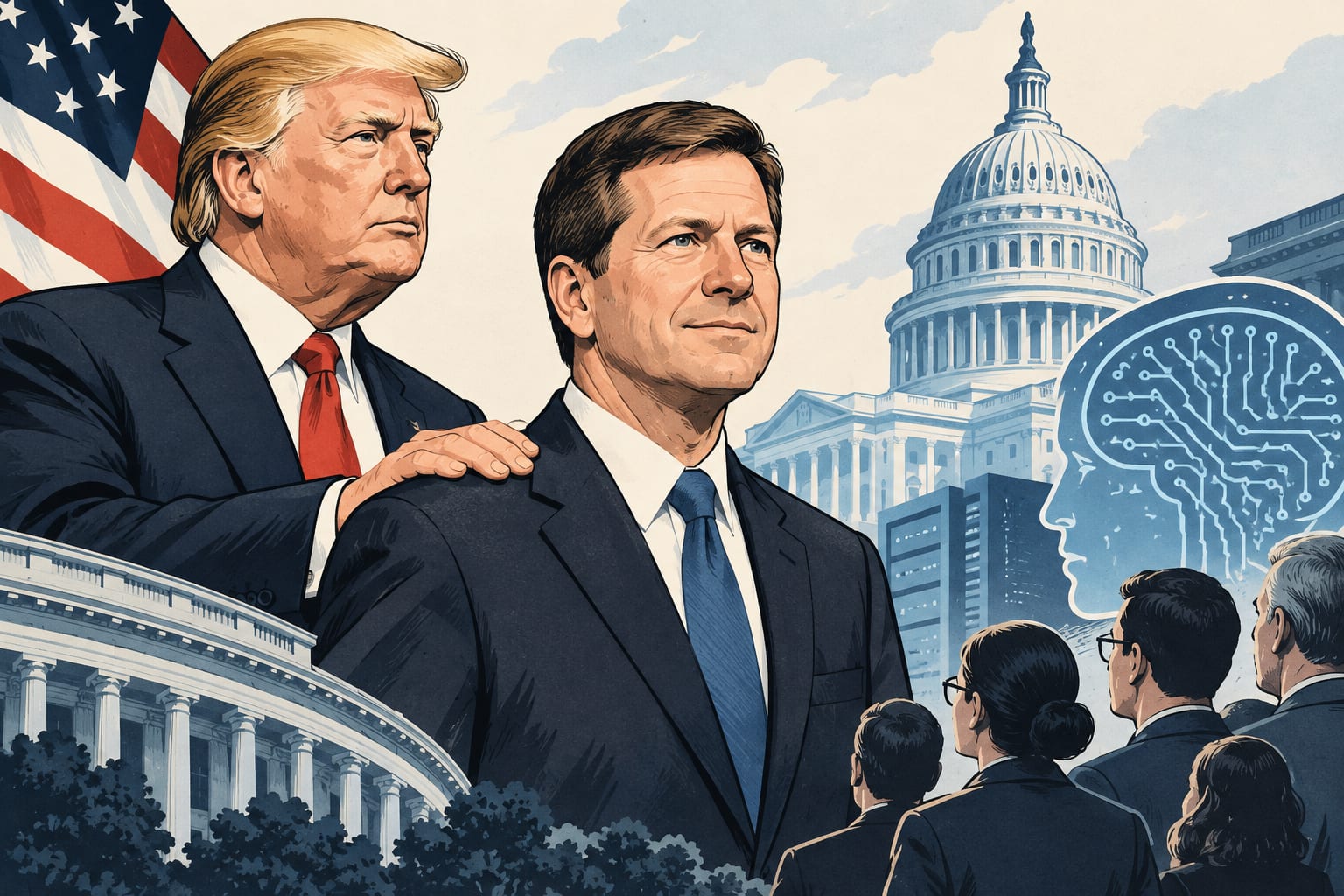
Trump Taps Jay Clayton as AI Czar, and Washington Wants to Know if Regulation Finally Moves
President Donald Trump announced Sunday that Jay Clayton, currently director of national intelligence, will take charge of the administration's artificial intelligence portfolio. The move puts Clayton at the helm of what Trump, in a Truth Social post, called a "Super Intelligence Force," tasked with coordinating the federal government's engagement with consumers, public interest groups, religious organizations, critical infrastructure providers and what Trump termed "Super Intelligence Companies."
The naming convention is not incidental. Trump signed an executive order on Sept. 29 directing federal agencies to start referring to AI as "super intelligence." In an interview with The Wall Street Journal published Saturday, Clayton said the new task force will have 120 days to deliver a report on the risks and opportunities of AI and to recommend what role the government should play going forward.
Clayton will not be working alone. Undersecretary of Defense for Research and Engineering Emil Michael, Office of Personnel Management Director Scott Kupor and Federal Trade Commission Chairman Andrew Ferguson will serve as vice-chairs. The roster also includes Vice President JD Vance, Defense Secretary Pete Hegseth, and outside advisors such as venture capitalist David Sacks, who held the AI and crypto czar role in the administration until March.
Several former officials told Nextgov/FCW they are hoping Clayton's leadership will mean actual engagement with Congress on AI guardrails, rather than another round of voluntary frameworks. "Maybe he can work with Congress to help come up with some governance, some laws," one former Trump administration official said, speaking on condition of anonymity.
The part most coverage will miss
Buried in the announcement is a tension that nobody on the task force has resolved yet. Trump has repeatedly opposed new regulations on tech companies, arguing they would hurt U.S. competitiveness with China. But when he first floated the AI czar idea and the creation of an AI Force in a Truth Social post last month, he also said his administration would be "looking for BAD" in AI development. Those two instincts, deregulation and vigilance, have not been reconciled in anything released so far.
There is also a model sitting in the administration's own recent history that nobody has pointed to directly. One former Trump official said they hoped the task force would eventually function like the National Space Council, which advised the president on space policy and coordinated government and commercial efforts. That council was revoked by Trump in a December 2025 executive order. The official still sees it as the template Clayton's group could follow, distilling input from across sectors into actual policy recommendations rather than just producing a 120-day report that sits on a shelf.
Analysis: watch what gets measured, not what gets promised (Opinion)
An analyst who tracks this space closely has made a habit of ignoring the titles and personnel announcements and looking instead at the deliverables written into the fine print. Here, the number that matters is 120 days. That is the window Clayton has to report on risks, opportunities and the government's proper role. Everything else, the Truth Social language, the "Super Intelligence" rebrand, the roster of vice-chairs, is theater until that report lands and someone checks whether its recommendations survive contact with Trump's stated opposition to new tech regulation.
The framing offered by Arati Prabhakar, who ran the White House Office of Science and Technology Policy under Biden, deserves more attention than it is getting. She argues the entire "balance innovation versus safety" framework that dominates AI policy debates is wrong, that safety is not a trade-off against progress but a precondition for it. If Clayton's task force adopts that framing, it would mark a real shift. If it doesn't, the 120-day report will likely just restate the same innovation-versus-safety tension that has stalled progress for years.
The other side
Not everyone treats the task force as cosmetic. Rep. Don Beyer, D-Va., co-chair of the Congressional Artificial Intelligence Caucus, acknowledged that a task force alone cannot substitute for federal regulation, but he framed Clayton's appointment as a potential opening. Beyer compared Trump's posture on AI risk to his stance on climate change, which Trump has called a hoax, and said he wants the president to move past dismissal and toward genuinely weighing input from AI leaders on how to structure oversight. That is a lower bar than binding legislation, but it is not nothing.
The question to ask now
When the 120 days are up, will Clayton's report propose anything Congress can actually legislate, or will it arrive as another set of principles that Trump's deregulatory instincts quietly bury?
As Clayton steps into this role, industry observers are already analyzing ai regulation backlinks across policy documents to predict potential governance frameworks.
Source: Nextgov/FCW
Still catching up? Start with Google Beats Publisher Lawsuits Over AI Overviews, But the Fight Isn't Over