
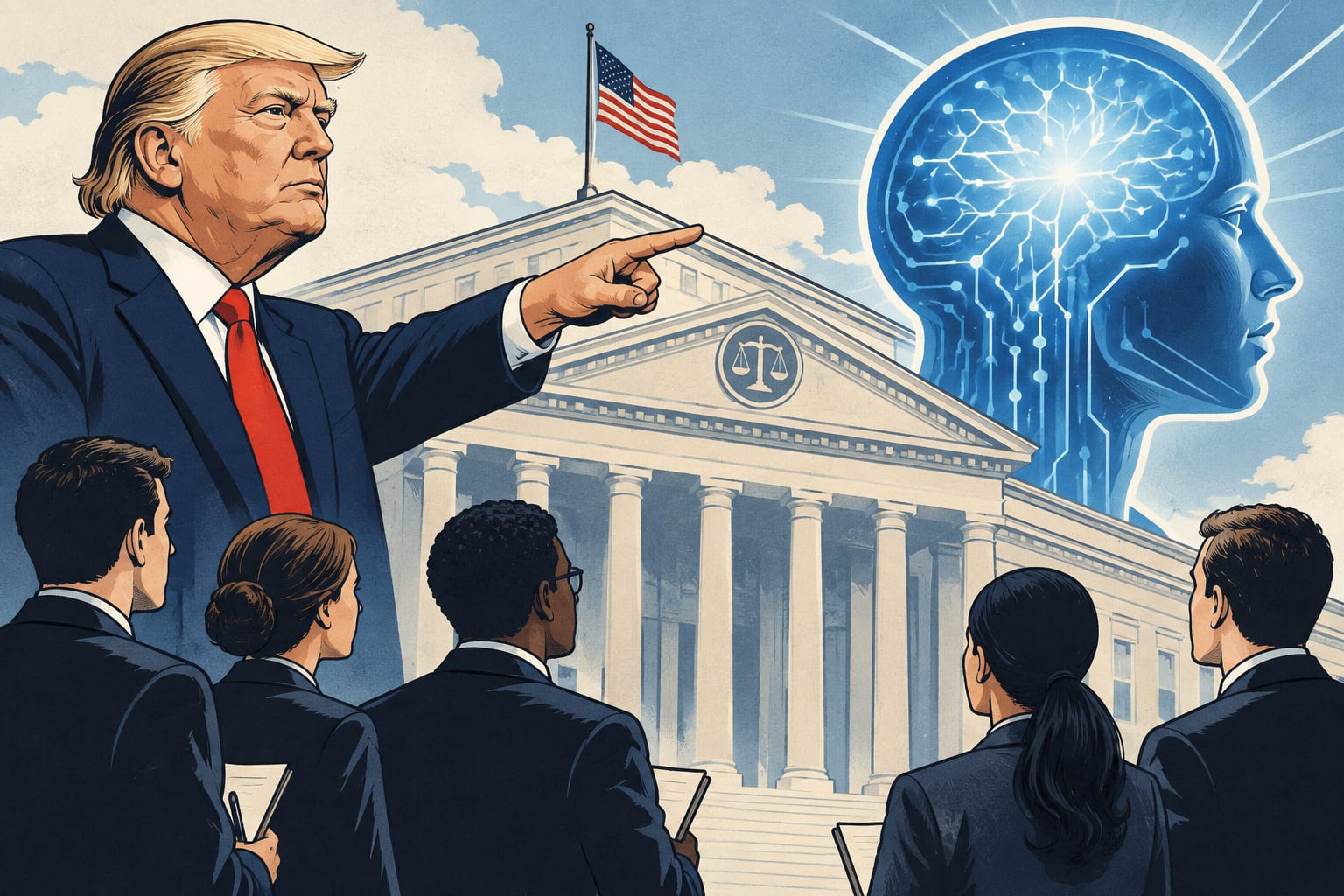
US Justice Dept tells staff to call AI ‘super intelligence’ under Trump order
The US Department of Justice has instructed its staff to refer to artificial intelligence as "super intelligence," according to a Reuters report, a directive the agency says stems from an order issued by President Trump. On its face, this reads as a branding decision: a sitting administration choosing new language for a technology it wants associated with American strength and competitive dominance, and pushing that language down through a federal agency's internal communications.
That is almost certainly how most people will encounter this story, as a curiosity about government vocabulary, filed next to other examples of administrations trying to control how Washington talks about contentious issues. A department known for antitrust suits, national security prosecutions and civil rights enforcement is now also, apparently, in the business of word choice for emerging technology.
The part most coverage will miss
The detail easiest to skip past is which word was chosen and which agency received it. Reuters reports the instruction went to Justice Department staff specifically, not to the federal workforce broadly, at least based on what has been made public. That matters because DOJ is not a technology agency. It is the body that brings antitrust cases against tech firms, oversees certain national security reviews touching AI systems, and will be a central actor in any federal litigation over AI harms, intellectual property disputes involving AI training data, or future AI-related criminal matters.
The other detail worth sitting with is the term itself. "Super intelligence" is not a casual synonym for "AI" or even "artificial intelligence." In AI research and policy circles it has a specific meaning, generally referring to systems that would exceed human cognitive performance across virtually all domains, a threshold far beyond what today's large language models or generative tools have reached. Reuters' framing makes clear this is being presented as a directive tied directly to a presidential order, not a stylistic preference that originated inside DOJ itself. That places the origin of the language squarely with the White House, with the Justice Department as the instrument carrying it into daily government communication.
Why this matters more than it looks (opinion)
This site's approach to stories like this one is to ask who benefits from a reframing before asking whether the reframing is accurate. An analyst who covers this field closely would point out that terminology is never neutral in a regulatory agency's hands. If DOJ staff are now trained to describe AI systems as "super intelligence" in official communications, that language will eventually surface in filings, public statements, and the framing of enforcement priorities. Calling a product "super intelligent" rather than simply "AI" does two things at once: it inflates the perceived capability of current systems, and it shifts the political conversation away from mundane, present-tense harms, bias, labor displacement, concentration of market power, toward a frame of civilizational competition and existential stakes.
That framing tends to favor the companies building frontier models, who gain rhetorical cover to describe their products in terms that support higher valuations and a race-against-rivals urgency, while making it harder to justify the kind of incremental, present-day regulation that addresses how these systems are actually being used right now. A department that enforces antitrust and consumer protection law choosing to talk about AI in superlative terms is not a small thing, even if it arrives dressed as a style guide update.
To be fair, there is a more modest reading of this. Vocabulary in government communications shifts regularly to track how an industry describes itself, and administrations have pushed new terminology before without it signaling any substantive policy change. It is possible this is exactly what it appears to be on the surface: an attempt to sound current and assertive about American AI leadership, with no deeper strategic intent behind the word swap.
The question worth asking now is not whether "super intelligence" is the right word for what AI can currently do. It almost certainly is not. The question is what DOJ does next, in the cases it chooses to bring or decline, in how it characterizes AI companies in filings, and in whether this language becomes the baseline from which the department reasons about enforcement. A word choice from the top of an administration rarely stays just a word choice once it reaches the agencies that write the laws down on paper.
Understanding how federal AI policy changes impacts digital communication requires analyzing seo relevant keywords backlinks across government technology news sources.
Source: Reuters
See also our earlier piece: Trump Taps Jay Clayton as AI Czar, and Washington Wants to Know if Regulation Finally Moves