
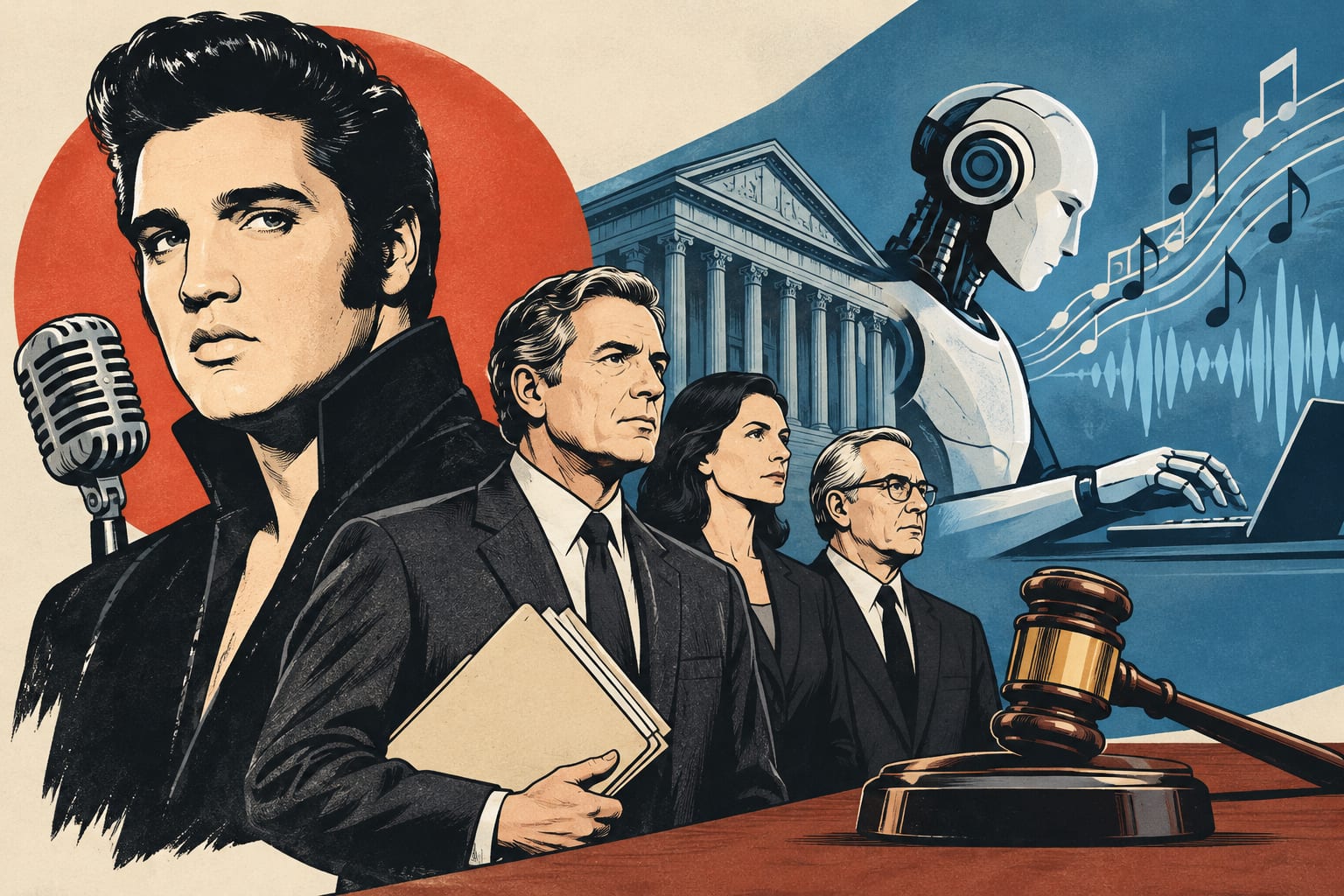
Elvis Presley’s Music Owners File New Lawsuit Against AI Music Generator
The owners of Elvis Presley's music catalog have filed a new lawsuit against an AI music generator, adding one of the most recognizable names in American music to the growing list of rights holders pushing back against artificial intelligence companies in court.
The suit, reported by WREG.com, places Presley's catalog owners in the same fight that has already drawn in major record labels and publishers over the past two years. The core complaint in this wave of litigation has been consistent: AI music generators are trained on copyrighted recordings without permission, and the resulting tools can produce output that competes directly with the original works, undercutting the value of catalogs that labels and estates have spent decades building and licensing.
Elvis Presley's catalog is not just another asset on a balance sheet. It is one of the most heavily licensed and merchandised bodies of recorded music in history, and it continues to generate revenue through film, television, advertising and streaming deals more than four decades after his death. Any legal fight over how that catalog can be used, copied or approximated by a machine carries weight well beyond the courtroom.
The part most coverage will miss
Most of the coverage racing out on this story will focus on the obvious: a famous name, a famous catalog, another lawsuit against an AI company. What tends to get flattened in that version of the story is the business logic behind the timing. Catalog owners do not file suits like this reactively. They file them when a tool has reached a scale or a feature set that makes the threat concrete, not theoretical. A lawsuit against a music generator is as much a statement about where that technology has arrived as it is about any past infringement. The filing itself is evidence that whoever manages the Presley rights believes the product in question has crossed a line worth litigating, not just monitoring.
It is also worth noting what is absent from the public summary of this story: no settlement figure, no specific description of the infringing output, no detail on what the AI tool actually generated. That gap matters. It means the case is, at this stage, a legal opening move rather than a resolved dispute, and the real substance will emerge in filings and discovery rather than in the headline.
Analysis (opinion)
This site's analyst, who has made a habit of reading these filings for the angle the wire copy skips, points to a pattern worth watching rather than the headline itself. Music catalogs tied to deceased artists have become one of the most active fronts in AI litigation precisely because they are singular. A living artist can adapt, collaborate with new technology, or negotiate licensing terms in real time. An estate cannot speak for itself; it can only litigate. That makes estates and legacy catalog owners the most predictable and most motivated plaintiffs in this fight, and it suggests more of these suits are coming, not fewer, as AI companies continue to expand what their tools can replicate.
The other side
AI music companies and their defenders have generally argued that training models on existing recordings falls under fair use, comparing it to how human musicians learn by listening to and absorbing the music that came before them. They also point out that the tools can generate entirely new compositions rather than verbatim copies, and that treating training data as inherently infringing could chill a legitimate and fast-growing industry before courts have settled the underlying legal questions.
The question to ask now
The headline will fade once the next AI lawsuit lands, as it inevitably will. The more useful question is what happens to the next generation of legacy catalogs, from musicians whose estates have not yet had to make this call, once a legal precedent is actually set. Who moves first when the rules finally get written, and who gets left negotiating from a position decided by someone else's lawsuit?
Publishers covering this Elvis Presley lawsuit against an AI music generator often rely on seo relevant keywords backlinks to help readers discover coverage of AI and copyright disputes.
Source: WREG.com
Catch up on our earlier post: Lee Odden Says B2B Influence Now Has to Satisfy Two Audiences: Buyers and AI