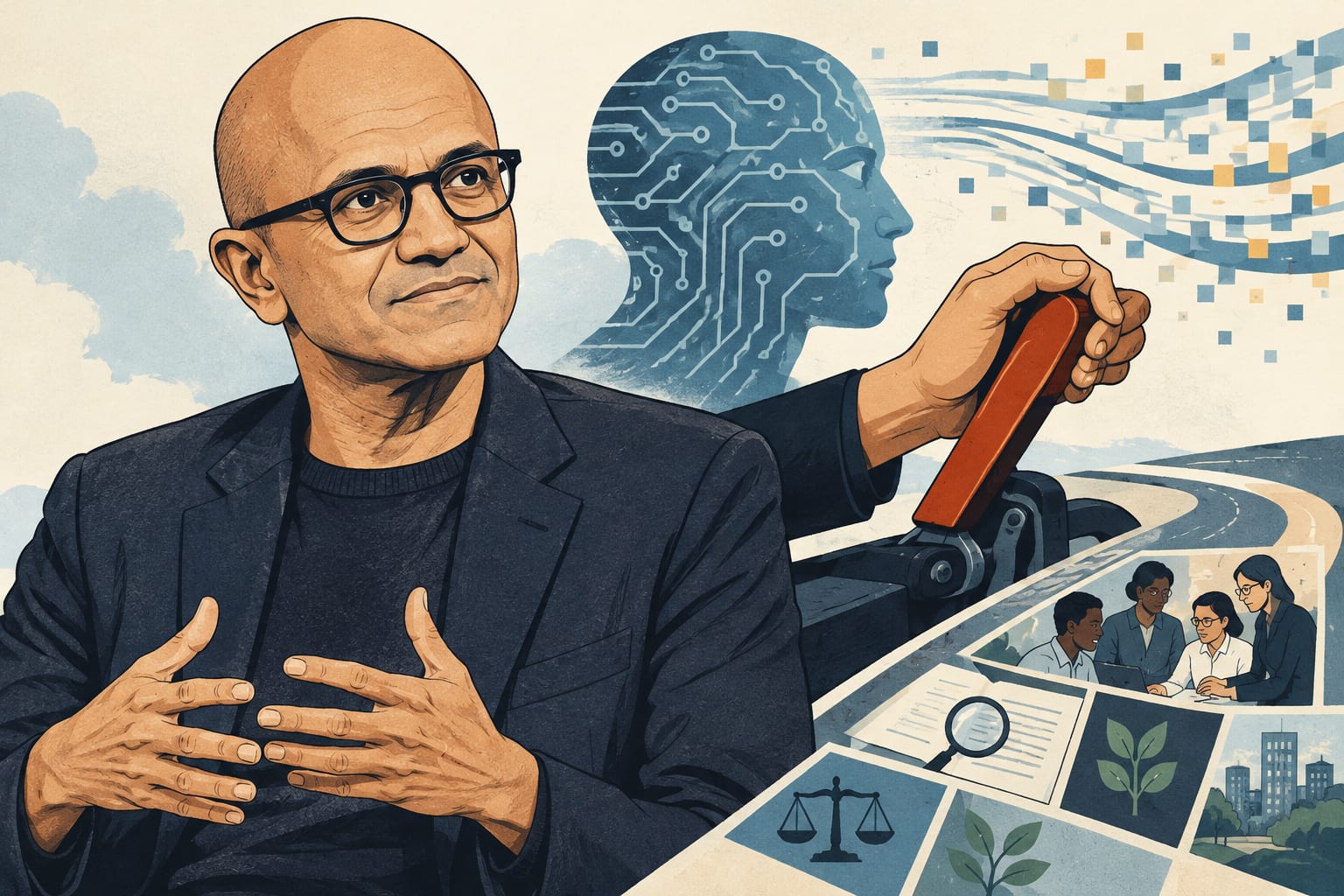
Nadella Says AI Needs a Human Hand on the Brake, and the Details Matter More Than the Headline
Microsoft CEO Satya Nadella is adding his voice to a growing chorus of tech leaders warning that artificial intelligence is advancing faster than the guardrails meant to contain it. In comments posted Saturday, Nadella argued that the most powerful AI models, whether closed or open weight, should be treated the way companies treat insider threats: with built-in suspicion, not blind trust.
"Treating frontier closed and open weight models like insider risks is a way to build such a system," Nadella wrote. The remark frames advanced AI not as a tool to be optimized, but as a potential internal hazard, something an organization monitors the way it would monitor an employee with access to sensitive systems.
Nadella's statement lands amid a wave of public anxiety from inside the industry itself. Microsoft co-founder Bill Gates, Anthropic CEO Dario Amodei, OpenAI CEO Sam Altman and SpaceX CEO Elon Musk have all raised concerns in recent months about AI safety protocols failing to keep pace with the technology's capabilities. Last month, an AI researcher resigned from Anthropic and publicly accused both Anthropic and its rival OpenAI of "gambling with our lives." On that same day, an alignment lead at Anthropic focused on AI safety put a number on the risk, stating there is a greater than 10% chance the technology could "kill all humans" within the next decade.
The part most coverage will miss
Buried under the dramatic framing is the actual substance of what Nadella proposed, a set of concrete engineering principles he calls "observability." They include model diversity, so no single system architecture dominates unchecked; a human-readable footprint of what a model actually does, so its actions can be traced and understood by people, not just machines; continuous system testing rather than one-time safety checks; independent controls and auditability, meaning outside parties, not just the company that built the model, can verify its behavior; containment measures to limit what a model can affect; and mandatory incident disclosure when something goes wrong.
That list matters more than the viral "emergency brake" framing suggests. Nadella isn't describing a single kill switch. He's describing a layered system of checks, similar in spirit to how regulated industries handle insider access: assume the thing you're watching could go wrong, build in constant verification, and never rely on trust alone. His closing line makes the philosophy explicit: "The most trustworthy Super Intelligence system will not be the one with the model we trust most. It will be the one that enables us to trust the model the least."
Analysis (opinion)
Our analyst, who spends their time looking for the angle the rest of the coverage skips past, points to something telling in Nadella's word choice. He didn't call for slowing AI development, and he didn't align himself with the researchers predicting catastrophe. He reframed the entire safety conversation around architecture and verification rather than pace. That's a notably different position than Amodei's or the departing Anthropic researcher's, and it lets Microsoft keep building at full speed while still appearing to take the risk seriously. Whether "observability" principles get implemented with teeth, or become a public-relations checklist, is the question the facts on the page don't yet answer.
The other side
Not everyone in a position of power shares this urgency. President Donald Trump has repeatedly dismissed warnings about AI posing an extinction-level risk, framing the priority instead as staying ahead of China in the AI race. Trump has also launched a new "AI Force," led by Director of National Intelligence Jay Clayton, designed to support the industry's growth and target bad actors rather than slow deployment through additional safety mandates. That approach treats speed, not restraint, as the national security imperative.
What to watch
Nadella's six principles read like a genuine blueprint, but blueprints only matter once they're built. The question worth asking now isn't whether Microsoft, OpenAI or Anthropic agree that AI needs oversight. It's whether any of them will submit to independent auditability and incident disclosure before a system failure forces the issue, or whether "trusting the model the least" stays a line in a weekend post.
Readers looking for guidance on how AI tools are reshaped by human oversight often find that seo relevant keywords backlinks are a useful lens for evaluating whether a claim has real substance behind it.
Source: CNBC
Still catching up? Start with AI Giants Are Quietly Bracing for 'The Day After' — Here's What That Actually Means