YouTube Music Will Tell You When a Song Isn’t Human. It Won’t Tell You What Happens Next.
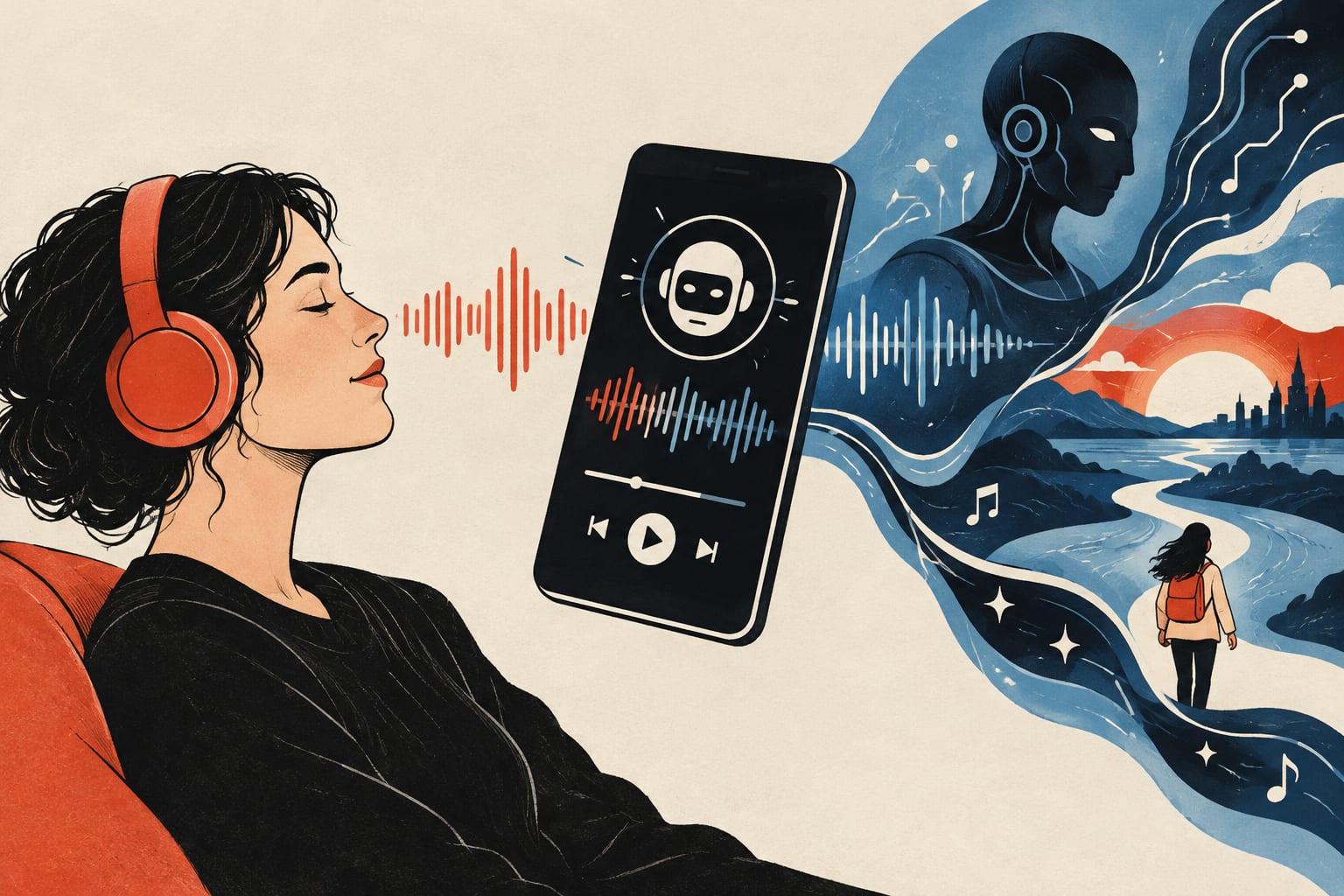
YouTube Music has started labeling tracks made "primarily using generative AI," the company announced in a blog post published Wednesday, October 14. The Google-owned platform says listeners who play a track where AI played a significant role will see a label directly on the player page. Tapping that label opens a menu with more information about how the track was made.
YouTube gave one example of what qualifies: a song built with "a generative model to create the composition and vocals." The company says the labels will also roll out to the main YouTube app, not just the music service.
To identify these tracks, YouTube says it's combining two sources: disclosures from its music partners and its own detection tools. "As these tools evolve, our listeners have told us they want transparency when they're hearing an AI-generated track," the company said in its announcement.
A Help Center page for music partners lays out how the disclosure side works. Partners delivering content through DDEX or CSV templates can tag tracks with one of three labels: "Fully Gen AI," "Partly Gen AI," or "No Gen AI." YouTube's own examples draw the lines: a track pulled straight from an AI generator after a text prompt counts as fully AI. An artist who uses AI to build a bassline or string arrangement, then adds their own vocals and instrumentation, falls under partly AI. Auto-Tune and AI-assisted mastering don't count as AI generation at all under YouTube's framework.
The move puts YouTube Music alongside a growing list of platforms rolling out their own AI disclosure systems, each built slightly differently.
The part most coverage will miss
The Help Center page contains a detail that didn't make YouTube's blog post: partner declarations aren't the final word. "YouTube may use additional signals to augment partner declarations," the page states. If a partner submits no AI information at all, YouTube says it "will rely solely on those signals and may designate content as fully or partly Gen AI" on its own.
The page also hands partners a surprising amount of discretion, stating plainly that "it is up to partners to interpret the Gen AI definitions provided by DDEX in relation to their content." In other words, the three-tier system depends heavily on how individual labels and distributors choose to read the same rules.
Neither the blog post nor the Help Center page explains what labeling actually changes for a song once it's tagged. There's no mention of whether flagged tracks are treated differently in recommendations, and nothing about royalty payouts. The blog post also never clarifies whether "Partly Gen AI" tracks will even carry the visible player label, despite the category existing in the partner system. One of the Help Center's own examples for "Partly Gen AI" is a song with entirely human-performed audio paired with an AI-generated music video, raising the question of what exactly listeners would be shown in that case.
The post links back to YouTube's May update for AI video labeling, where the company said labels would apply automatically when its systems detected "significant photorealistic AI use," even without creator disclosure. That same update stated flatly that a disclosure label "alone does not change how a video is recommended or whether it's eligible to earn money." YouTube Music's announcement doesn't repeat or contradict that line for music.
Analysis (opinion)
Our analyst, who makes a habit of reading past the press release to what the fine print actually permits, flags the gap between labeling and consequence. YouTube has built a system that can flag a song as AI-made but has said nothing about whether that flag touches the two things artists actually care about: visibility and money. Compare that with TIDAL, which said in June it would stop paying royalties on fully AI-generated music, or Spotify, which said in August it would keep AI-persona profiles out of its editorial and algorithmic recommendations by default. YouTube's language so far describes a transparency feature, not an economic one. Given its May precedent on video, where it said explicitly that labels don't affect money or reach, there's reason on the page itself to expect music labeling could work the same way.
The other side
YouTube isn't alone in moving cautiously. Apple Music's "Made With AI" tags, set to go live later this year, also depend entirely on labels and distributors declaring AI content rather than independent detection. Spotify's AI disclosure test, which began in April, likewise runs through artist labels and distributors. Judged against that company, YouTube's willingness to layer its own detection tools on top of partner declarations is arguably a step further than some competitors have gone.
What to watch
Deezer said this week that it now receives nearly 90,000 fully AI-generated tracks a day, and the RIAA and IFPI proposed voluntary industry labels for this content back in July. YouTube has built the signage. The open question is whether it will ever say what the sign is actually for.
Creators looking to grow their channels often pair strong music metadata with seo relevant keywords backlinks to help listeners discover their tracks.
Source: Music Business Worldwide
Earlier in this series: Anthropic's Trillion-Dollar Debut Arrives Wrapped in Doubt and Warnings of Doom