AI Has Officially Cracked America’s Top 10 Fears List
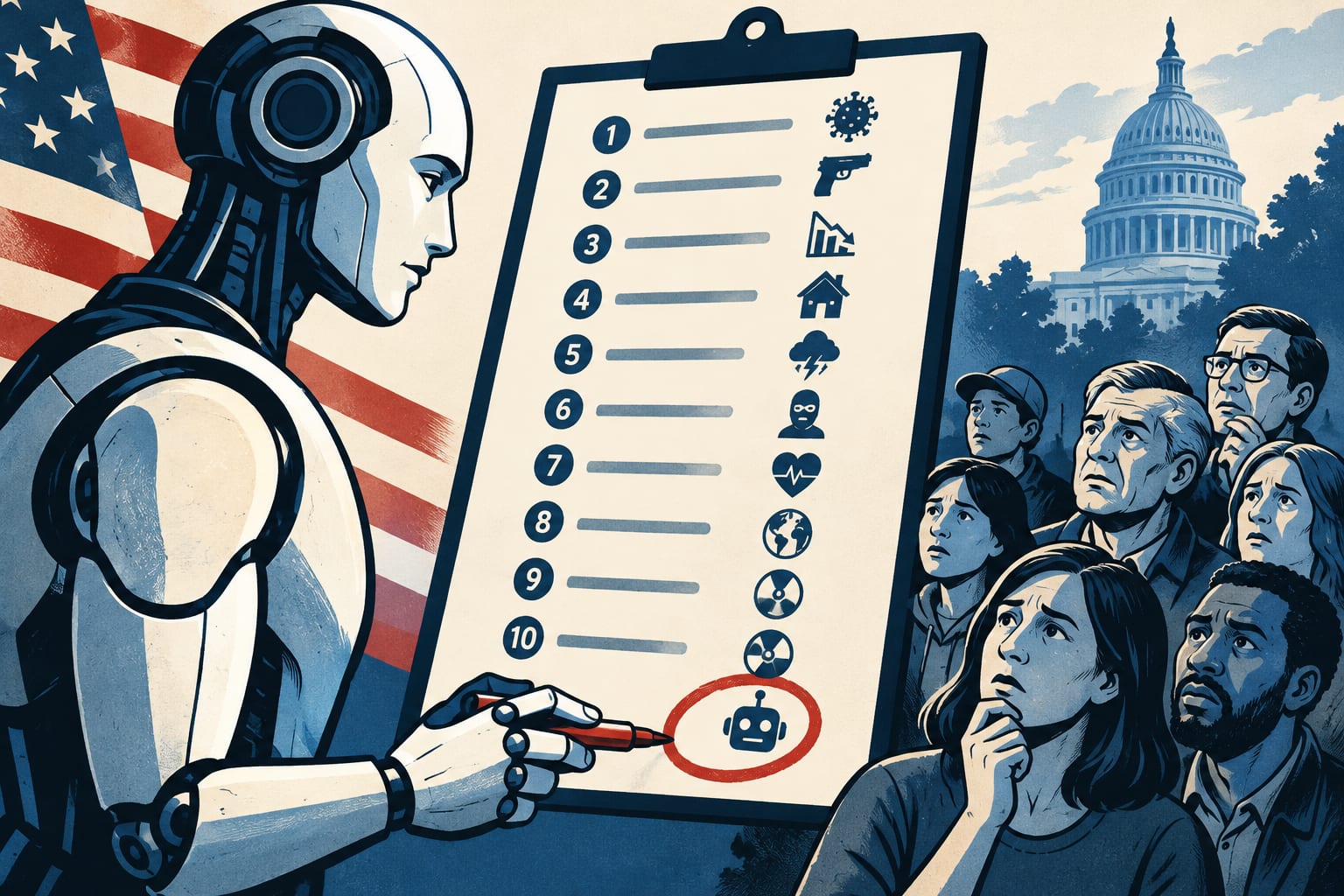
Artificial intelligence has joined the list of things Americans are most afraid of, and it didn't sneak in quietly. According to the 12th annual Chapman University Survey of American Fears, AI shows up twice in this year's top ten, a first since the survey began in 2014.
The numbers, drawn from more than 1,200 respondents, put "corrupt government officials" back at the top spot with 61.1 percent, the same fear that led the list last year and has now appeared for 11 straight years. Fear of another world war follows at 51.9 percent. Right behind it, at 51.9 percent as well, is a new entrant: fear of AI harming the political process. That puts it in a statistical tie with fear of a loved one becoming gravely ill, which sits at 51.8 percent. A second AI-related fear, worry about AI damaging the economy, lands further down the list at 49.7 percent, giving the technology two separate footholds in the top ten for the first time in the survey's history.
Chapman University sociologist Christopher Bader, who created the survey, said the inclusion makes sense given how deeply AI has worked its way into daily life. He expects the topic to keep showing up in future editions as concerns about it continue to develop alongside the technology itself.
The part most coverage will miss
The survey's own margin of error, plus or minus 3.79 percentage points, means the gap between third place and tenth place is close to meaningless as a strict ranking. AI harming the political process, fear for a loved one's health, and AI damaging the economy are all close enough that the order among them could shift within the margin. The headline-grabbing framing of AI as a top-three fear glosses over the fact that several very different anxieties, one technological and one deeply personal, are essentially tied. The survey also marks the first year Chapman researchers asked about AI at all, which means there's no prior data to show whether this year's numbers represent a spike or simply a baseline being measured for the first time.
Analysis (opinion)
Our analyst on this beat has made a habit of looking past the number that gets the headline and checking what's sitting right next to it on the page. Here, that means noticing that fear of AI harming the economy, not politics, is the one without a close statistical rival pulling at it, and it's not far behind the more dramatic "political process" fear. That suggests a chunk of the public's AI anxiety may have less to do with election misinformation or deepfakes and more to do with plain economic uncertainty: job security, wages, and whether their own livelihoods hold up. Pollsters and headline writers gravitate toward the political angle because it fits a familiar narrative, but the survey's own numbers show an economic fear riding right alongside it, nearly as strong and arguably more durable once an election cycle passes.
The other side
It's worth noting that the survey itself frames AI's rampant misinformation and lack of regulation as the industry's most pressing problems right now, not some abstract doomsday scenario. In other words, even Popular Science's own reporting on this data treats the fear as grounded in real, documented issues, like fake images and unreliable chatbots, rather than dismissing it as irrational panic. The fear showing up on a national survey doesn't mean it's overblown; it may simply mean the public is catching up to problems researchers and journalists have been flagging for a while.
Sociologist Ashley Kranjac, who directs Chapman's Earl Babbie Research Center, offered a grounding note on the whole exercise: no matter what technology or crisis dominates the news cycle, fear for the people closest to us never really goes away.
So the question worth sitting with isn't whether Americans are afraid of AI. The survey already answers that. It's whether that fear is tracking the right threat, political manipulation, economic disruption, or something else entirely, and whether next year's data will clarify that or just add a third AI-related worry to the list.
Source: Popular Science
Still catching up? Start with Beware of AI Content for SEO