China Moves to Lock Down Its Own AI Exports, Citing National Security
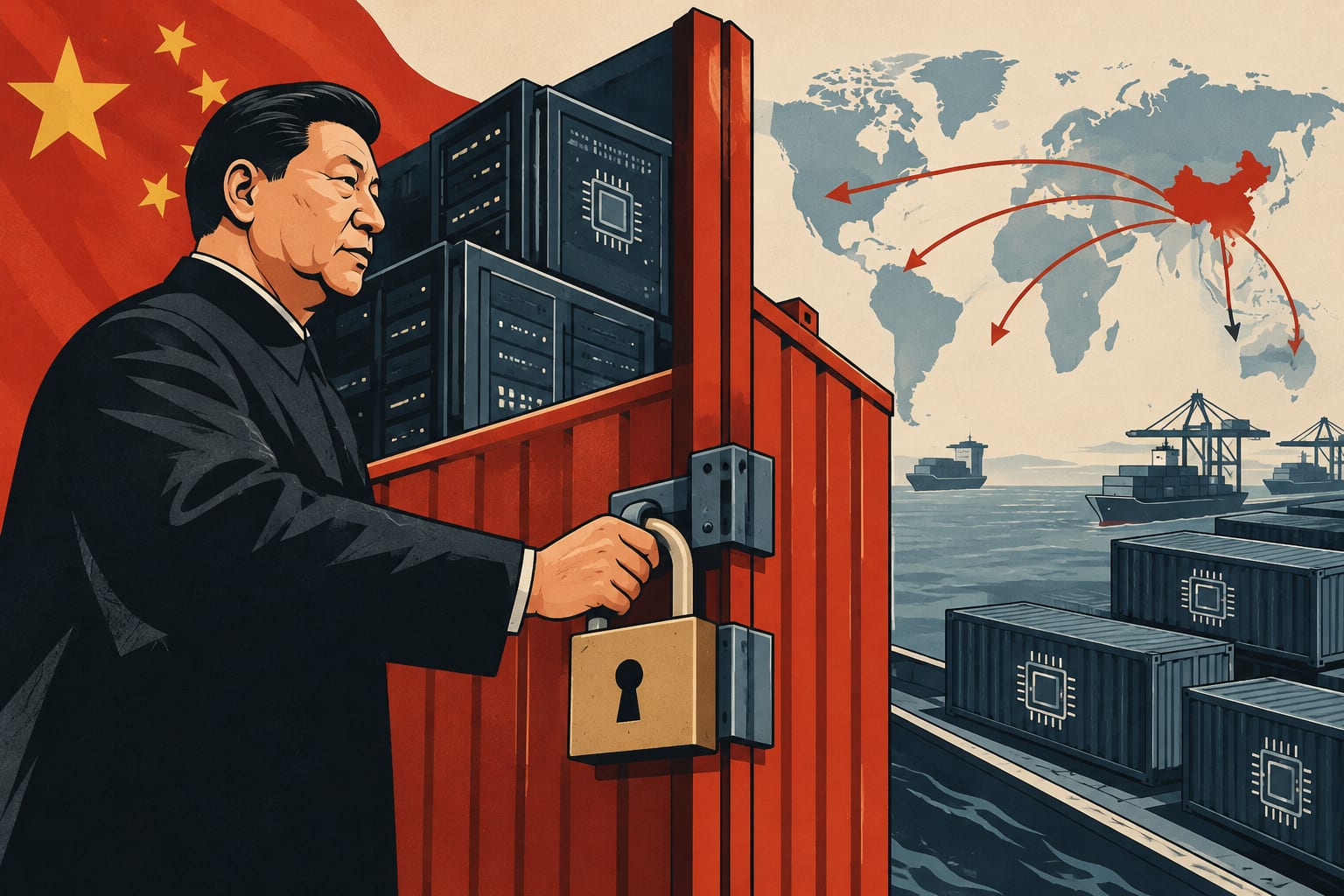
Beijing announced Friday that it intends to restrict or ban the export of 40 technologies, including artificial intelligence systems, advanced chips and solar power components, in a move Chinese officials say is necessary to protect national security.
The Ministry of Commerce and the Ministry of Science and Technology jointly released a draft update to China's catalog of export-controlled technologies. A commerce ministry spokesperson called the move "necessary," pointing to national security as a central justification. The proposal lands as China and the United States have reportedly been making progress on dialogues about AI safety and governance, including work toward a notification system for AI incidents that could threaten national security in either country.
For most readers, the headline is simple: China is tightening its grip on AI exports the same way the United States has tightened its grip on chip exports to China. That read is accurate as far as it goes. Twenty-three of the 40 technologies on the list are AI-related, covering everything from advanced large language models to autonomous AI agents. U.S.-led restrictions have already cut China off from the most advanced AI chips and the chipmaking equipment used to produce them, so a Chinese countermeasure fits the pattern of a technology rivalry that has been escalating for years.
The part most coverage will miss
The draft isn't a blanket AI export ban. It draws careful lines. Export of core AI large-model technologies trained on sensitive national data would be prohibited outright, as would AI agents built for use in highly sensitive settings like national defense or critical information infrastructure. But other AI models face only possible restriction, not prohibition, specifically those with parameter counts of 2 trillion or more, or those with certain world-leading capabilities. Parameter count is a standard measure of an AI model's learning capacity, and Chinese models including Moonshot's Kimi K3 and Alibaba's Qwen 3.8-Max already exceed that 2 trillion threshold. The proposal does not name any specific models it would apply to.
The list also reaches well beyond AI. It includes several chip design technologies, covering some AI processing chips and memory chips, plus twelve solar power technologies tied to polysilicon production, the core raw material in the solar supply chain, and five biomedicine technologies related to cell and gene therapy. The breadth suggests this is less a single AI policy than a broad recalibration of what China considers strategically sensitive to let leave the country.
Analysis (opinion)
An analyst who watches this field for the angle others skip over would note that this story is being framed almost entirely as "China restricts AI," when the more interesting read is that China is drawing a border around its most advanced models precisely because it now has models worth restricting. A country doesn't write export controls for technology it can't yet produce. The specificity of the proposal, naming parameter thresholds and carving out exceptions for prohibition versus mere restriction, reads less like defense and more like inventory management for a technology base Beijing now considers a genuine asset. That's the detail easy to miss in a story that gets covered as simply another round of US-China friction.
The other side
Not everyone frames this as confrontation. Lian Jye Su, chief analyst at Omdia, described the move as a response to Western countries imposing their own sovereignty requirements on AI, robotics and telecommunications, suggesting Beijing's goal is to better regulate access to Chinese technology rather than escalate tensions. Gary Ng, a senior economist at Natixis, added that AI has become strategically important to both countries as trade, investment and technology access all grow more fragmented worldwide. The episode in which the U.S. Commerce Department asked Anthropic to restrict foreign access to two of its powerful models before later lifting those restrictions shows that this kind of back-and-forth tightening and loosening isn't unique to China.
What to watch next
The real question isn't whether China is restricting AI exports. It's what Beijing considers worth protecting, and what that list says about which of its own models and chips it believes have become too valuable to hand over freely.
Source: PBS
Still catching up? Start with YouTube Tightens Monetization Rules for AI-Generated and Low-Quality Content